The Attack on Human Reality
Cognitive hacking is the deliberate manipulation of human thought. It targets perception, memory, judgment, and decision-making by using digital channels like
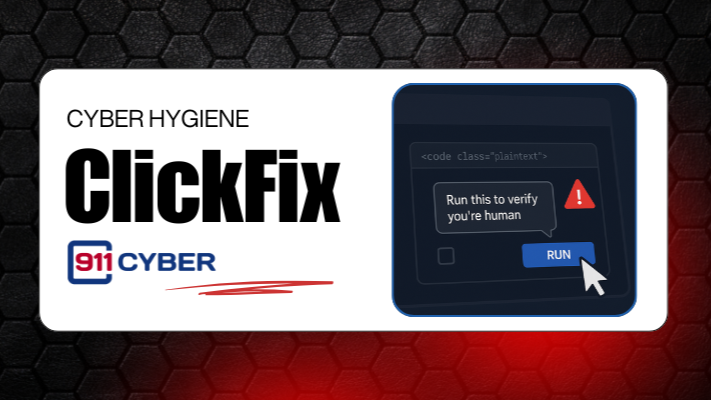
ClickFix is a social engineering technique where an attacker convinces you to run a command or paste code on your device. The prompt often appears as a CAPTCHA, a verification step, or a “fix this error” message. The user executes the command themselves, which triggers malware or gives the attacker access.

ClickFix is important because it marks a shift in how attackers operate. Instead of relying solely on software vulnerabilities or attachments, they are exploiting the most consistent weakness of all: the user.
When you are told to “paste this code” as part of what looks like a normal workflow, you become the delivery mechanism.
This method is particularly dangerous because:
The future of cyber defense must include not only technology but also behavioral hygiene, teaching people that sometimes the act of clicking or pasting itself can be the threat.

ClickFix is neither. It is a social engineering tactic. It is the delivery method or the “con.” It represents the psychological tricks (the visual lure) used to convince a user to manually run malicious commands on their own computer. These commands, once run by the user, then proceed to download the actual malware (such as infostealers, Remote Access Trojans (RATs), or ransomware).
While Windows is a primary target, attackers are also adapting the technique for macOS.
Not reliably, as ClickFix is designed to bypass these tools. The attack bypasses traditional file-scanning AV because it is often “fileless” (executing only in memory). It can bypass many EDR solutions because the user is the one performing the malicious action (bypassing “human intervention” checks) , and they are using trusted, legitimate system utilities (like PowerShell) to do it.
Because it leverages human behavior rather than strict technical vulnerabilities, making it scalable and effective for attackers.
By shaping both technical controls (restricting Run/Terminal) and behavioral controls (training staff, building pause culture).
The tactic is used by a very broad spectrum of actors, which is why it is so dangerous.
Cybercriminals: It was pioneered by financially motivated groups, specifically the initial access broker TA571 and the ClearFake cluster. It is now widely used by countless criminal actors to deploy commodity malware like the Lumma Stealer.
State-Sponsored (APT) Groups: In a major strategic escalation, ClickFix has been adopted by nation-state espionage groups. Researchers have confirmed its use by APTs linked to North Korea (TA427), Iran (TA450, MuddyWater), and Russia (APT28, TA422).
📚Books
Social Engineering by Robert W. Gehl & Sean T. Lawson
Phishing for Phools by George A. Akerlof
🎙️ Podcasts
Hacking Humans (by the CyberWire) hosted by Dave Bittner, Joe Carrigan and Maria Varmazis
Human Factor Security by Jenny Radcliffe
▶️ Video
AI ClickFix: Hijacking Computer-Use Agents with popular social engineering tricks, like ClickFix. By Embrace The Red
The ClickFix attack makes it clear that in 2025, the human element is the main battleground. Technology alone is not enough to stop these threats; the most effective, and often only, defense is teaching people to pause, question, and verify.
Attackers using methods like ClickFix exploit human actions, not just software vulnerabilities. That means the best defense combines technology with behavior. While having the right tools is important, building a culture where the team automatically follows a “stop, question, verify” mindset is just as critical as the latest endpoint protection.
Ultimately, the strongest defense is one that recognizes the user as both the target and the essential front-line defender.



A free 15-min cybersecurity consultation